When we dip a wooden scoop into a fresh sack of flour, our fingers register subtle differences long before the water hits the mixing trough. Unbleached all-purpose flour feels soft, cool, and pillowy, compressing easily between thumb and forefinger like sifted chalk. Strong bread flour carries a faintly coarser grit, an indicator of the dense endosperm milled from hard wheat berries. In sourdough baking, these tactile variances translate directly to how dough behaves on the bench, how it drinks water, and how it expands inside a hot baking vessel.
Every baker eventually faces the decision between these two foundational bags. Many classic recipes call broadly for white flour, leaving us to decide whether to reach for the familiar grocery store all-purpose or an artisan bread flour with higher tensile strength. Choosing one over the other shifts your entire workflow: your target hydration, the frequency of your stretch and folds, bulk fermentation timing, and the final tooth of the crumb. Understanding the structural dynamics of each flour allows us to make deliberate adjustments at the counter rather than guessing why a loaf fell flat or turned out tough.
Understanding Protein Content and Ash Levels
The defining distinction between all-purpose and bread flour lies in the protein fraction, specifically the storage proteins glutenin and gliadin. When hydrated, glutenin provides tenacity and elasticity (the ability of dough to snap back), while gliadin provides extensibility (the capacity to stretch without tearing). Standard all-purpose flour milled from a blend of soft and hard wheat usually lands between 10.2% and 11.7% protein. Bread flour, almost exclusively milled from hard red winter or hard spring wheat, sits higher, typically between 12.4% and 14.1% protein.
Ash content is an equally vital metric that receives far less attention. Ash represents the mineral residue left behind if a sample of flour were burned in an incinerator, composed mainly of minerals from the outer bran coat. Standard roller-milled all-purpose flours generally exhibit an ash content around 0.45% to 0.50%. Bread flours, particularly those milled for artisan bakers, frequently retain ash levels between 0.55% and 0.68%. These residual minerals act as nutrients for yeasts and lactic acid bacteria, slightly quickening fermentation rates and contributing an earthier depth to the final bake.
These two metrics shape the physical architecture of the gluten mesh. A higher concentration of protein creates more cross-linked bonds across the dough matrix, forming tight pockets that hold gases under pressure. A lower protein flour forms a looser, more delicate sheet that yields readily to gentle pressure but tears when pushed too far.
| Metric | Standard All-Purpose Flour | Artisan Bread Flour |
|---|---|---|
| Typical Protein Range | 10.5% to 11.5% | 12.7% to 13.8% |
| Standard Ash Content | 0.44% to 0.49% | 0.54% to 0.62% |
| Primary Wheat Blend | Hard red and soft white | Hard red spring or winter |
| Damaged Starch Ratio | Moderate (6% to 7%) | Higher (8% to 9%) |
Hydration Adjustments for Different Grains
Flour does not absorb water equally. Damaged starch granules created during hard roller milling, combined with high concentrations of gluten-forming proteins, pull moisture inward. Because bread flour contains more protein and slightly more damaged starch, its thirst is substantially greater than that of all-purpose flour. Pouring 78% hydration into an all-purpose flour dough often results in a soupy, slumping mass that pools across the bench, while bread flour absorbs that same volume into a supple, workable cushion.
When working exclusively with unbleached all-purpose flour, we generally set our base hydration between 66% and 71%. At this level, the dough preserves enough surface tension to be shaped into a taut boule or batard without collapsing into a flat disc. If you shift the formula over to a strong bread flour, you can raise the hydration safely to 76% or even 82% without losing structural integrity.
To adjust an existing sourdough formula between these two grains, apply these practical guidelines:
- Transitioning from Bread Flour to All-Purpose: Lower the total recipe water by roughly 5% to 7% of total flour weight. For a batch using 500 grams of flour, reduce the water by 25 to 35 grams. Hold back another 20 grams during initial mixing, adding it only after observing how the flour hydrates during the autolyse.
- Transitioning from All-Purpose to Bread Flour: Increase water by 4% to 6% of total flour weight. The dough will feel stiff and resistance-heavy early on. Give the mixture a full 45 minutes of resting time before assessing whether it needs an additional splash of moisture.
Dough Elasticity During Bulk Fermentation
Handling dough across the bulk fermentation window highlights the mechanical contrast between these flours. Bread flour dough feels muscular. When you slip wet hands underneath to execute a coil fold, the dough resists your lift, lifting in a clean, unified sheet from the edges of the tub. It holds sharp corners in the container and stores gas bubbles under high internal tension. This elasticity ensures excellent oven spring, but it can also make final shaping strenuous if the gluten has not relaxed sufficiently.
All-purpose dough behaves with graceful extensibility. During coil folds, it drapes downward under its own weight, elongating into a thin, translucent membrane without snapping back immediately. This property makes all-purpose pleasant to laminate or shape, as it rarely resists the bench knife. However, because its tensile strength is lower, all-purpose dough degrades faster under the enzymatic action of prolonged fermentation. Protease enzymes, which clip protein chains over time, will turn a fragile all-purpose dough soupy if bulk fermentation runs past its optimal window.
We modify our manipulation schedule based on the flour choice:
- For Bread Flour: Space folds 40 to 50 minutes apart. We limit interventions to three or four rounds of folding, allowing the strong gluten network ample time to relax between cycles so the loaf does not become rubbery.
- For All-Purpose Flour: Space folds closer together, roughly 25 to 30 minutes apart, applying four to five gentle folds early in the cycle. This builds mechanical structure quickly before acid accumulation weakens the gluten bonds.
Crumb Openness and Crust Chew Comparison
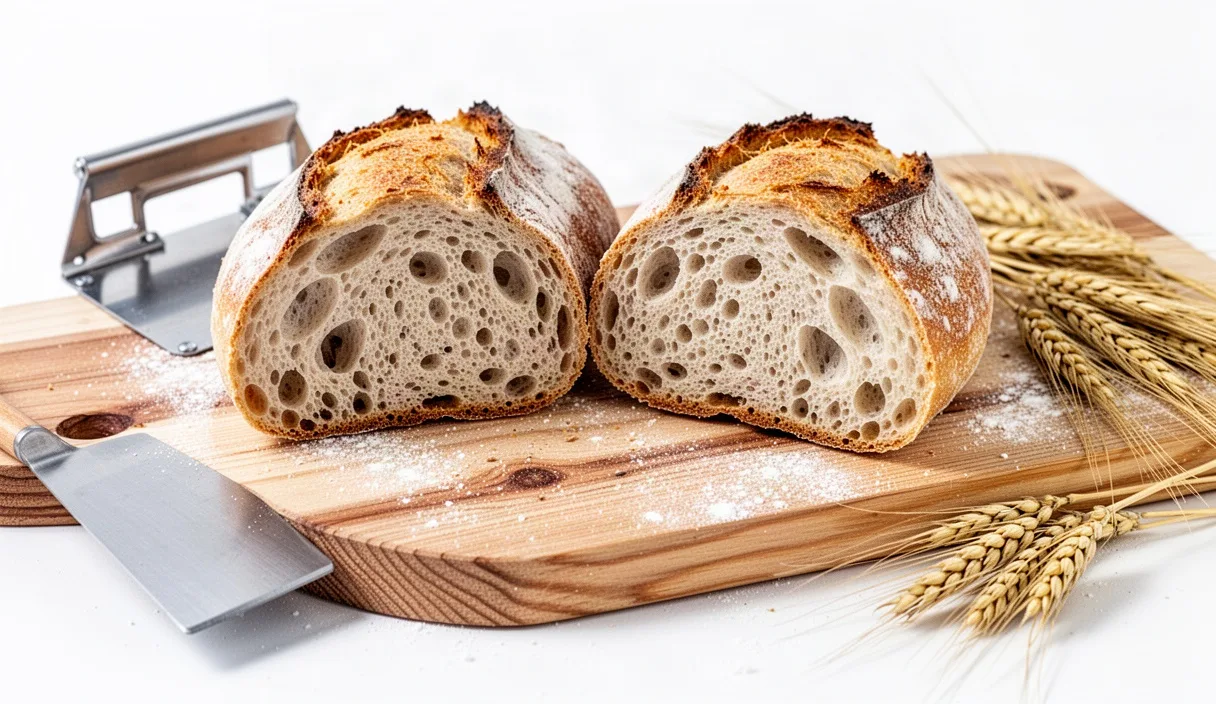
The structural choices made at the bench reveal themselves fully once the bread cools and the crumb is sliced open. Bread flour yields thick, glossy cell walls around the air pockets. The internal structure shows a bold, three-dimensional geometry with tall alveoli that hold their shape even under the pressure of a serrated knife. When bitten, a pure bread flour loaf offers distinct tooth and chew, a substantial physical presence that suits hearty sandwiches or thick slabs meant to support wet toppings.
All-purpose flour creates a radically different interior. The cell walls are thin, sheer, and tender. While the crumb may not feature the cavernous, wild openings of a high-protein bake, it frequently displays a remarkably even, honeycombed lace that feels custardy on the palate. A pure all-purpose loaf dissolves softly in the mouth without requiring prolonged jaw work, making it exceptionally suited for table bread, soft toast, and dinner service.
The crust tells a matching story. Bread flour produces a sturdy, blistered shell that stays crisp over hours on the wire rack, retaining a loud crackle under hand pressure. All-purpose flour yields a thinner, crisp-shatter crust with pale golden tones that softens more rapidly into a gentle chew as ambient humidity settles into the loaf.
Choosing Flour Based on Ambient Room Temperature
Ambient conditions in your kitchen alter the balance between fermentation velocity and gluten degradation. In a warm workspace (76 to 82 degrees Fahrenheit), wild yeasts and bacteria reproduce rapidly, producing acid that accelerates the breakdown of the gluten web. In these conditions, all-purpose flour can quickly lose structural tenacity, causing loaves to puddle during the transfer to the baker.
Under warm conditions, strong bread flour provides an essential structural buffer. Its higher initial protein reserves ensure that even after significant enzymatic softening, enough intact gluten strands remain to hold tension and sustain vertical rise in the oven. The dough stays resilient through the final proof.
In a cooler kitchen (63 to 68 degrees Fahrenheit), fermentation moves at an idle crawl. Here, bread flour can become excessively rigid, contracting tightly during shaping and requiring long proofing windows to open up. All-purpose flour shines in cool environments. Its natural extensibility prevents the dough from seizing, allowing gentle acid accumulation to relax the structure without the risk of catastrophic collapse. The resulting bread turns out open, light, and tender without fighting the cold air.
Our Recommended Ratio for Everyday Loaves
Rather than committing solely to one sack, we have found that an intentional blend yields the best qualities of both grains: the loft and resilience of bread flour tempered by the soft bite and delicate crumb of all-purpose. This balance creates a dough that handles cleanly on wet wood, expands generously against a razor score, and offers a crisp crust that remains pleasant to chew.
Here is our working formula for an everyday hearth loaf:
- Bread Flour (12.7% protein): 315 grams (70%)
- Unbleached All-Purpose Flour: 135 grams (30%)
- Water: 328 grams (73% hydration)
- Ripe Sourdough Starter (at 100% hydration): 90 grams (20%)
- Fine Sea Salt: 9 grams (2%)
To bring this loaf together, follow this tactile sequence:
- Autolyse the Grains: Combine both flours with 310 grams of the water in a broad mixing bowl, reserving the remaining 18 grams. Stir until no dry pockets remain. Cover the bowl and let the mixture rest for 45 minutes to allow the starches to hydrate and autolytic enzymes to soften the protein strands.
- Incorporate Starter and Salt: Smear the ripe starter across the surface of the autolysed dough. Dimple it in with your fingertips, then sprinkle the salt and splash the remaining 18 grams of water over the top. Pinch and fold the dough repeatedly until the salt grains dissolve and the mass turns uniform and slightly tacky.
- Build Structure: Over the first two hours of bulk fermentation at 72 degrees Fahrenheit, apply three sets of stretch and folds spaced 30 minutes apart. Turn the bowl a quarter turn with each pull, stretching the dough upward until it resists, then folding it across its center.
- Rest and Preshape: Allow the dough to ferment undisturbed for another two to three hours until it shows rounded edges, domed tops, and visible bubbling beneath the surface. Tip the mass onto an unfloured wooden work surface, round it gently with a dry bench knife, and leave it uncovered for 20 minutes to relax.
- Final Shape: Dust the top with light rice flour, flip the dough, fold the lower third up and the sides inward, then roll the dough down into a snug cylinder. Place it seam-side up into a linen-lined banneton dusted with a 50/50 mix of rice flour and all-purpose flour. Chill in the refrigerator for 12 to 14 hours before baking in a preheated cast iron vessel at 450 degrees Fahrenheit.
Common Mistakes
A frequent error is treating all commercial all-purpose flours as interchangeable commodities. Regional milling profiles differ drastically. Nationally distributed Southern all-purpose flours often contain as little as 9.0% protein, suited for soft biscuits and quick breads, whereas Northern-milled unbleached all-purpose flours frequently carry 11.7% protein, which rivals some lighter bread flours. Check the nutritional panel: calculate the grams of protein per 100 grams of flour to know precisely what you are putting in your bowl.
Another regular misstep is pushing hydration too far on pure all-purpose sourdough. Chasing the high moisture percentages popularized by social media while using grocery store all-purpose produces a sticky paste that clings stubbornly to the hands and bench knife. High hydration demands the dense protein structure of strong flour; pushing all-purpose beyond 72% without substantial whole grain additions almost always yields flat loaves with dense bases.
Finally, avoid over-working bread flour out of habit. Because bread flour forms gluten readily, aggressive kneading combined with tight shaping can lead to a dense, rubbery loaf that cannot expand sideways in the oven. Treat high-protein dough with gentle, spaced folds rather than brute strength, allowing time and resting intervals to relax the structure naturally.
Practical Next Steps
The clearest path to dialing in your flour choice is a controlled split bake. On your next baking day, prepare two small, identical doughs side by side: one mixed entirely with unbleached all-purpose flour at 68% hydration, and the other with artisan bread flour at 75% hydration. Keep all other variables equal, including the starter percentage, water temperature, bulk ambient environment, and shaping styles.
Observe how each dough handles as you move from the initial autolyse through shaping. Note the resistance against your bench knife, the height of the dough in the proofing baskets, and the visual expansion under the blade when you score them. Once cooled, slice through the centers simultaneously. Feel the crumb textures, chew a piece of each crust without butter, and note how the structural variations alter your enjoyment of the bread. This tactile feedback will inform your hands far more accurately than any printed formula, showing you exactly which flour fits your kitchen tempo and palate.